
5 Questions Pastors Are Afraid To Ask About AI
Jun 16, 2026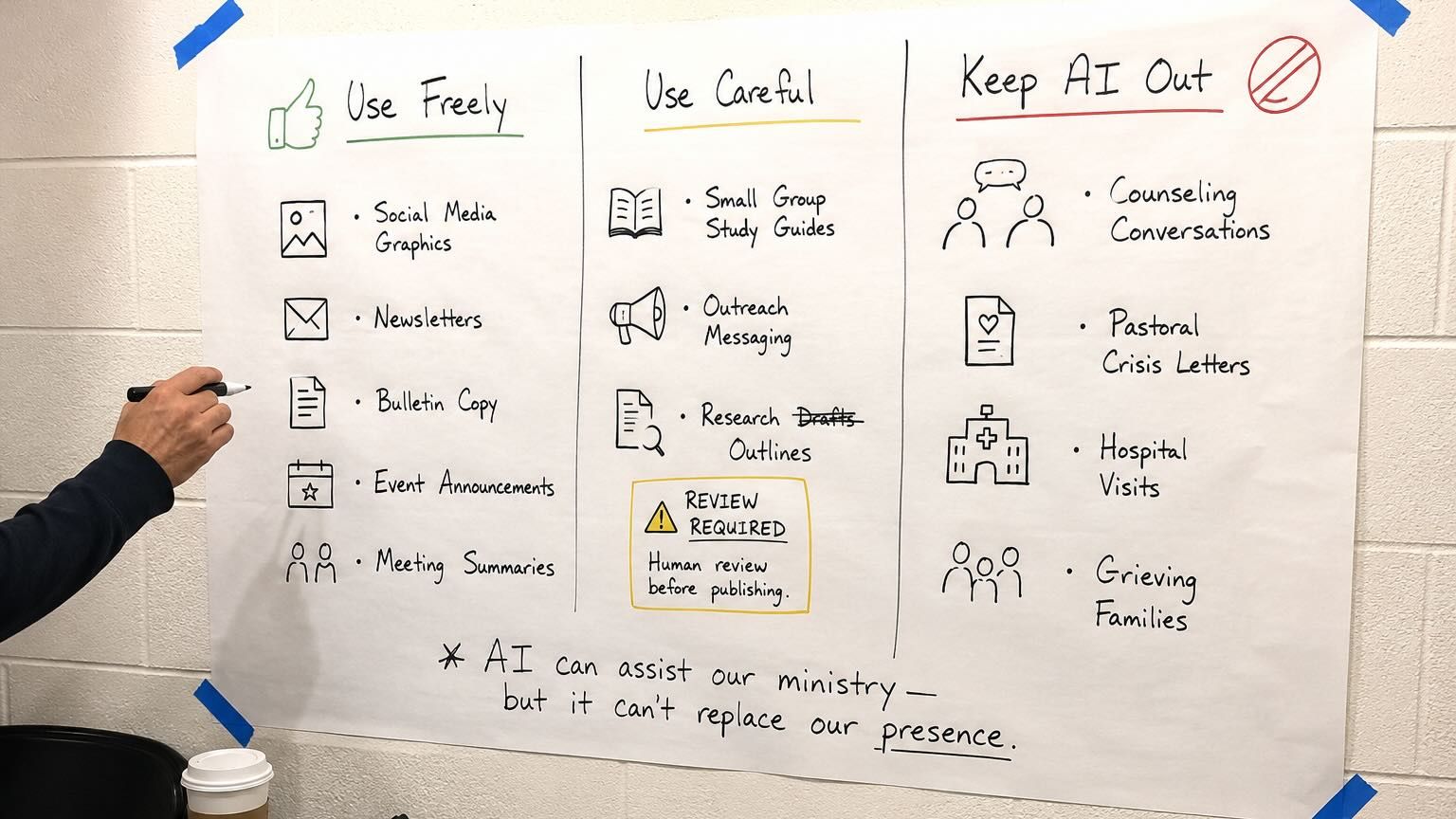
I've been in rooms where the question never gets asked out loud.
Leaders nod along to AI presentations. They smile. They take notes. And then, after the session, someone pulls me aside and whispers what they actually wanted to know.
These are those questions.
Question #1: I keep hearing about AI. Where do I even start?
I get this one more than any other.
Most pastors aren't asking whether AI is worth paying attention to. They've already crossed that bridge. What they're stuck on is the on-ramp. The first step. The moment where "I should probably learn this" becomes actually doing something about it.
Here's what I tell everyone who asks.
Start with one real problem you have this week.
A sermon illustration you can't find. A newsletter you've been putting off. An announcement that needs to sound better than what you drafted at 11pm. Open ChatGPT or Claude, describe the problem like you're talking to a smart friend, and see what comes back.
That's it. That's the start.
If your church already uses social media, email automation, or video streaming, you're already engaging with AI — you just didn't have to learn it consciously. This is the same. You learn it by using it on real work, not by reading about it.
The mistake most leaders make is waiting until they feel ready. You won't feel ready. The tool rewards experimentation, not preparation.
If you want a structured starting point, ChatGPTforChurches.com is the first course I recommend to every pastor and church leader. It covers what generative AI actually is, what it's good for, what it's not good for, and walks you through ministry-specific use cases so nothing feels abstract. You'll finish it with a working framework, not just a vague sense that you should be doing something.
Give it twenty minutes on something low-stakes this week. Then take the course. You'll be further ahead than most of your peers before the month is out.
The best time to start was a year ago. The second-best time is today.
Question #2: Do I need an AI policy for my church — and what does that even look like?
You need one. And most churches don't have one.
91% of church leaders support AI use in ministry. 61% use it frequently. And yet 73% have no AI policy whatsoever.
That gap is a leadership crisis dressed up as innovation.
Your people are using AI tools to prep small groups, answer pastoral emails, and create content for your church brand — right now, today — with zero shared framework for how to do it with discernment.
A policy doesn't need to be complicated. It needs to answer four questions: What's approved? What's off-limits? Who reviews before it goes public? And what do we tell our congregation about how we use it?
The fastest way I've seen churches get this done is through AIPoliciesMadeSimple.com. It's a masterclass that walks your leadership team through building a customized policy from scratch, with templates already built in. You don't have to start from a blank page. You don't have to hire a consultant. You just work through the process and come out the other side with something your staff can actually use.
Start there. Build from there. Revisit it every six months, because this space moves fast.
Transparency builds trust. Always. In every direction.
Question #3: Can I use AI for sermon prep without compromising my integrity?
This is the one I get most.
Yes — with one hard line.
Use AI to research, brainstorm, pull commentaries, and edit for clarity. Those are legitimate tools for legitimate work. Pastors have always used study tools, research assistants, and editorial feedback. AI is a faster version of that.
But here's where the line is.
AI simulates intellect. What it doesn't have is genuine emotion. True worship involves not just understanding God, but feeling deeply about Him.
A sermon isn't content production. It's a pastor pouring out what God has been doing in their interior life that week. The wrestling with the text. The 3am question that got answered by Tuesday. The moment a congregant's face came to mind while reading a passage.
AI can't manufacture that. And your congregation can feel when it's missing.
Use AI on the front end. Show up yourself at the back end.
Question #4: Should I preach about AI — and if so, what do I say?
You should. And sooner than you think.
The majority of younger churchgoers say they would welcome hearing biblical principles applied to AI in a sermon. They're already living inside these questions every day. They just don't know if their pastor is paying attention.
Here's the frame I'd use:
AI is a tool built by people who bear the image of a creative God. Like every tool, it reveals more about the hands wielding it than the tool itself. The real question isn't whether AI is good or dangerous. The question is whether we are using it to love God and love people — or to sidestep the sacred work that requires both.
Identity. Image-bearing. The theology of work. The meaning of personhood.
These aren't abstract doctrines right now. They're the most urgent practical sermons you could preach.
Your people need a biblical vocabulary for this moment. Give it to them.
Question #5: What should church staff actually use AI for — and what should they stay away from?
This is the practical question underneath all the theological ones.
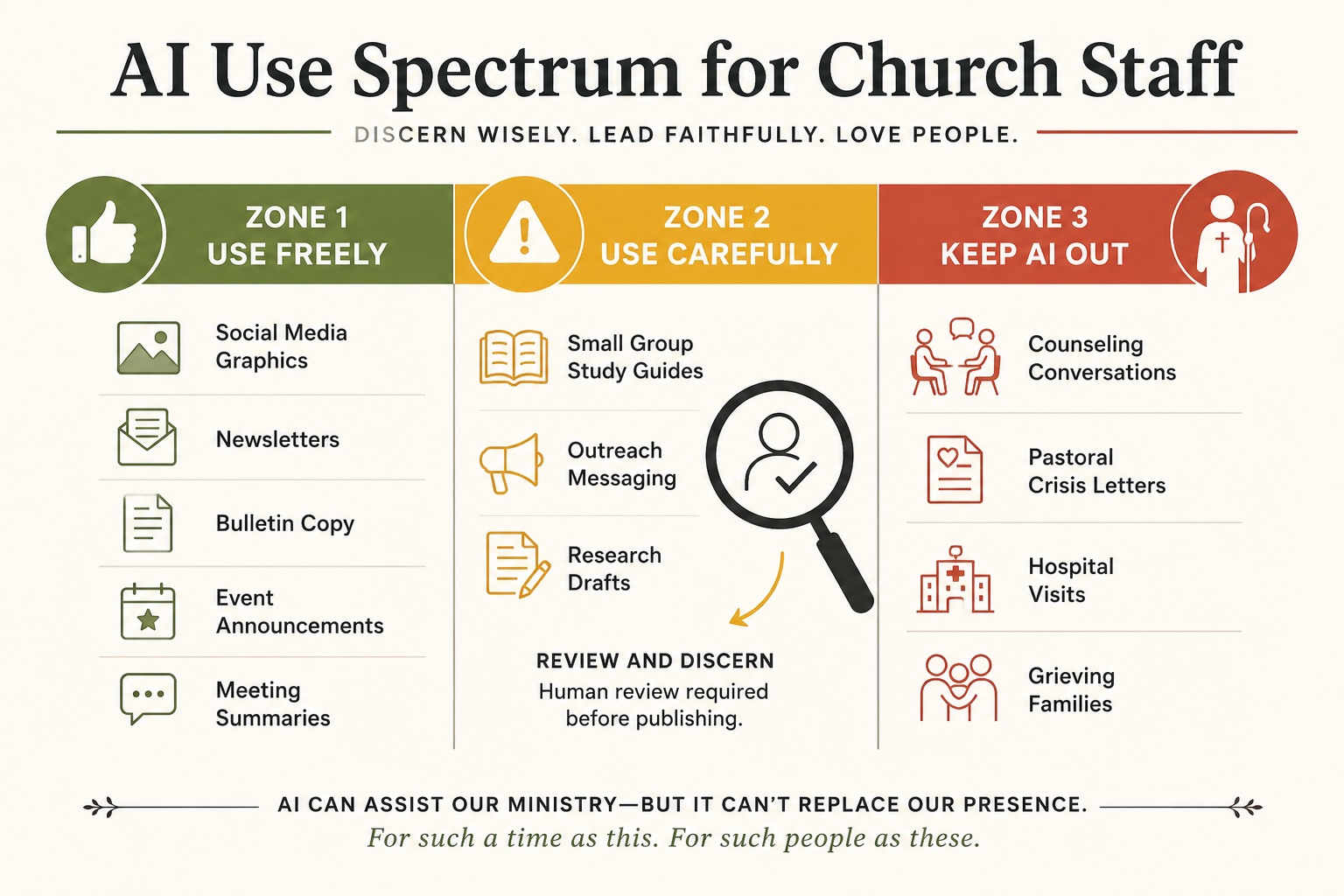
Think of AI as an intelligent seminary intern. It reduces administrative burdens, allowing pastors to focus on higher-value, people-centered ministry. But just as you wouldn't outsource pastoral care to an intern, don't use AI as a shortcut for spiritual leadership.
Use AI freely for graphics, social media drafts, bulletin copy, event descriptions, email newsletters, meeting summaries, and research starting points.
Use AI carefully for small group study materials and outreach messaging — always review for theological accuracy before it ships.
Keep AI away from counseling responses, pastoral letters in crisis moments, and anything where the human presence of a shepherd is the entire point.
For church staff who want to go deeper, AIforChurchLeaders.com has a video training library built specifically for ministry teams. It's practical use cases, not theory. Your communications director, your children's ministry coordinator, your admin staff — they can each find what applies to their role and start applying it the same week. No tech background required.
The best thing AI can do for your ministry is give your people more of you. More present. More pastoral. More human.
That's the mission it should be serving.
The Church has always arrived late to new technology.
And when it finally does arrive — the printing press, radio, the internet — history shifts.
The challenge is no longer whether churches adopt AI. It's how they use it with discernment, so that it enriches faith rather than hollows it out.
Your congregation is already in the AI age. The only question left is whether you'll show up as their guide for the life they must navigate going forward.