
You Found AI. Now You Have To Bring Everyone Else Along.
Jun 26, 2026
Maybe this sounds like you.
You started using ChatGPT or Claude with simple things. Probably for something small. A rough draft. A summary. A brainstorm you needed in a hurry.
And then it clicked.
You started saving real time.
You got excited about what you could produce with AI.
You mentioned it to people you work with, maybe dropped it into a hallway conversation or a team lunch.
And you got nothing back...
Polite smiles.
They kind of agree in the moment, but they don't seem to be using AI really.
In fact, they clearly already moved on... back to their routine ways of working.
THIS is where many AI-curious leaders get stuck.
You can see the opportunity.
The people around you can't yet.
And telling them to "just try it" doesn't work.
This is basically a change management problem. And it's up to you to lead it.
The gap between what you see and what your team sees is what's the issue.
Also, most people exposed to AI at work have a question running in the back of their head that haven't really processed or had conversations with others about deeply: "Is this thing going to end up doing what I do?"
That question creates a wall of some sort you're up against. And you can't push people through a wall by showing them productivity stats.
You have to become an evangelist. A patient one.
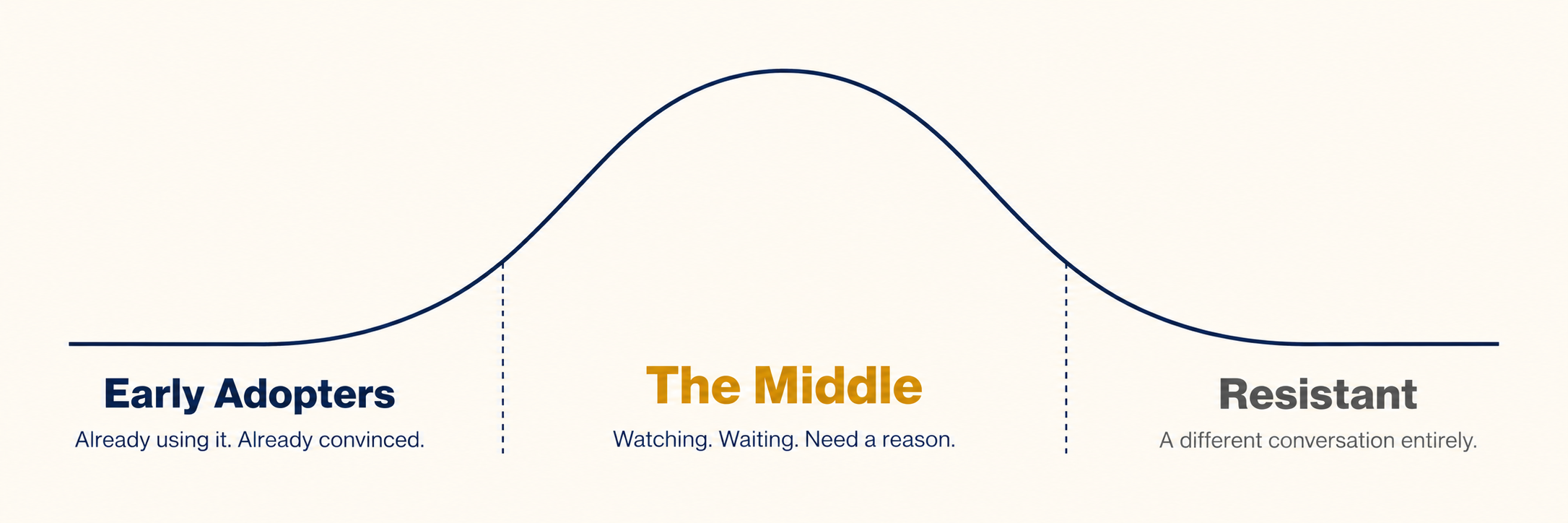
The early adopters? They'll find their way.
The people who flatly refuse? That's a separate conversation.
The group that actually matters most for your staff and teams right now is the large middle — curious enough to watch, skeptical enough to wait, and looking for a reason to care.
Here's what you can do to actually help them lean in on AI in the right ways.
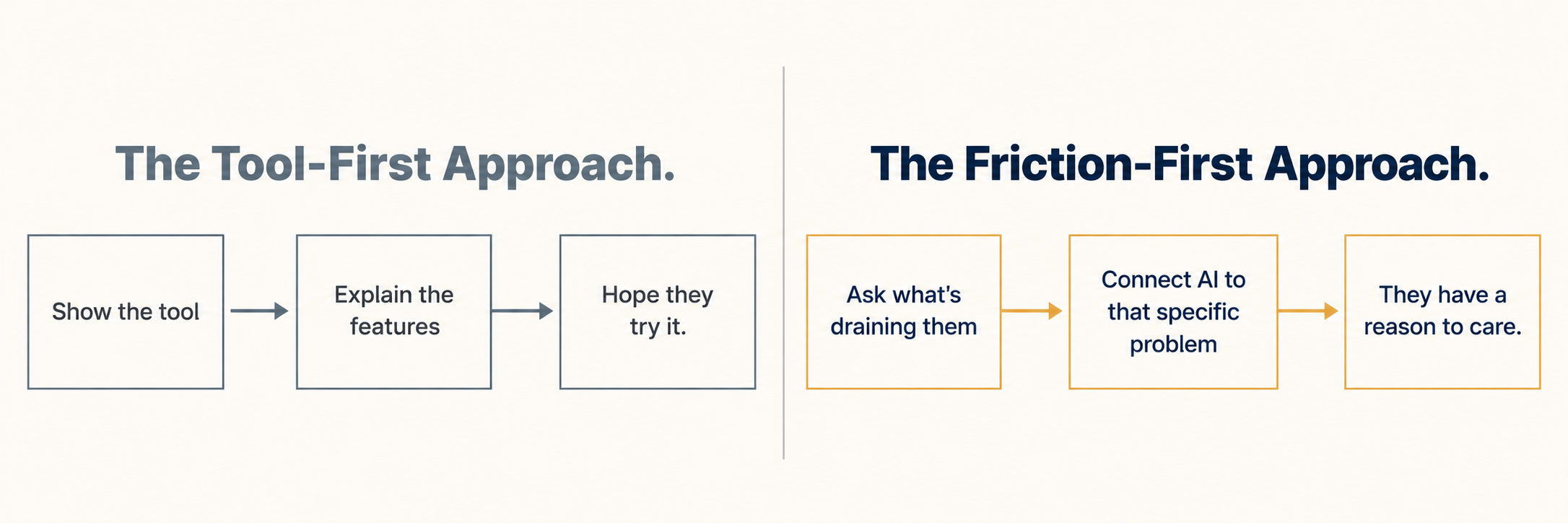
Step 1: Begin with friction, not features.
Skip the tool demo. Go find out what's actually frustrating people.
Pull individuals aside, one at a time, and ask them: what part of your job right now creates the most friction? What are you dreading this week? What task do you keep putting off?
You must give them permission to become self-aware of the parts of their daily work that is mundane and not life-serving.
When you start there, you stop being the person pushing a tool and start being the person solving a real problem. That changes everything about how the conversation goes.
Step 2: Show the failures too.
Most people who see others go on and on about AI wonders, think AI produces all this polished, impressive output on the first try.
It doesn't. You have to show them that.
Bring a prompt that gave you a completely useless response. Share the conversation that took thirty plus back-and-forths before it got anywhere useful.
Let people laugh at any of the AI failures you have witnessed (probably way too often too!).
Curiosity grows faster when the stakes feel low.
If AI looks like a magic box, the learning curve feels steep.
If it looks like a tool you have to work with, people can imagine themselves actually using it.
Step 3: Build formal spaces for it.
Adoption won't happen between meetings. Plan for it.
Set up a lunch-and-learn. A show-and-tell. A monthly 15 minutes where someone on staff shares one thing they tried with AI. Give people a venue to share wins and flops without it being a big deal either way.
Organic adoption is slow. Structured exposure sticks.
Step 4: Reframe the benefit theologically.
Time savings is a starting point. Don't stop there.
The deeper question for ministry leaders is this: what does faithful stewardship of your calling look like when you have tools this powerful available? AI can clear the repetitive and the administrative. What that frees up is attention, creative bandwidth, presence. Those things have always been the core currency of ministry.
You're really trying to find more capacity to do the work God actually called you to. That framing lands differently than "it'll save you an hour on Tuesdays." Help your team see it that way, and they'll carry it forward on their own terms.
Where are you in this? Are you still working on your own fluency, or are you already trying to bring others along?