
Hey there!
Think about everything you produced at work last week.
How much of it could a decent AI tool have generated in under an hour?
For most church staff that number is uncomfortably high, and the question that follows it is the one nobody is answering out loud. 87% of Protestant senior pastors now use AI in some capacity, according to Barna’s December 2025 survey. Sermon writing and editing with AI doubled in two years, from 12% to 24%. Meanwhile the labor market data has started arriving. Stanford’s Digital Economy Lab tracked ADP payroll records covering millions of workers and found that employment for 22 to 25 year olds in the most AI-exposed occupations dropped roughly 16% relative to their older colleagues in the same firms. Brookings estimates that office and administrative support is the single most exposed job family in America, covering nearly 19 million people.
Church staff work is largely office and administrative support with a theology degree attached.
So today I want to hand you a way to sort your own job into 4 layers, so you can see which parts disappear, which parts become your entire role, and what to do about it before someone else decides for you.
Let’s walk through each one.
Sort every task on your calendar by asking whether it needs a cart or a pallbearer.
We have had wheels for 6,000 years. A casket could be rolled to a grave by one person with a cart, faster and safer and cheaper than what we actually do. We use 6 people who loved the person instead.
That choice is deliberate. The weight is supposed to be carried by someone for whom the weight means something.
Some of your work is cart work. All of the value comes from the finished output, and nobody cares who made it or what it cost them. Nobody has ever been discipled by a bulletin.
Some of your work is pallbearer work. All of the value comes from the identity of the person doing it, and it evaporates the moment you hand it off.
AI is exceptional at cart work. Run the question across every line on your calendar this week: cart or pallbearer.
Some of your work is cart work. Some of your work is pallbearer work. AI is exceptional at cart work, and it will never be able to do the other kind.
Layer 1 is production, and it is already gone.
Production means making the artifact. Slides, graphics, bulletins, captions, social clips, email drafts, discussion questions, first-pass research, translation, transcription, blog repurposing.
Barna found 37% of pastors already using AI for graphic design and 34% for small group discussion questions. In the 2026 State of AI in the Church survey, 43% of church leaders reported using AI daily, roughly double the 2024 rate, with 93.5% engaging at some level.
Assume that by 2029, every artifact your church produces can be generated in under 5 minutes by someone with no design training and no seminary degree.
Then ask what you were actually being paid for.
Layer 2 is coordination, and it is most of your Tuesday.
Coordination means carrying information between people and systems. This layer will empty out faster than production, and almost nobody on a church staff is planning for it.
The technology doing this is agents, and it is arriving quickly. Job postings requiring agentic AI skills grew 280% in a single year, according to Stanford’s 2026 AI Index.
Here are 5 coordination jobs that will not have a human in the loop at most churches by 2031:
- Volunteer scheduling. Filling gaps, sending reminders, and finding a replacement when the nursery worker cancels at 6am on Sunday.
- First-time guest follow-up. Detecting the visit, sending the sequence, tracking the response, escalating only the ones that need a person.
- Giving statements and donor acknowledgment. Generating, personalizing, and reconciling against the database.
- Facility calendar management. Room conflicts, setup requests, and the eternal argument between youth group and the quilting ministry.
- Routine congregational questions. Service times, childcare policy, what you believe about baptism, how to sign up.
All of that is cart work.
Layer 3 is judgment, and it is about to become your whole job.
Every professional kitchen has a station called the pass. One person stands there and does not cook. They read every plate before it leaves and decide whether it goes out or goes back.
Give a line cook 10 capable assistants and within a week he has walked to the pass. He stands there now because 10 people producing food with nobody judging it is how a restaurant dies.
That is the shift running through every knowledge job in your building. Execution to orchestration. Your work becomes deciding what should be made, judging whether the output is true, and putting your name on what leaves the kitchen.
The World Economic Forum projects 170 million new roles created and 92 million displaced by 2030, and estimates that 59 of every 100 workers will need retraining. Most of that retraining is this one skill.
The expeditor’s only real ability is taste, and you cannot judge a plate you never learned to cook.
Layer 4 is presence, and delegating it destroys it.
Think about a letter of recommendation. Its value comes from one fact: a specific person put their name on it and staked something they can lose.
Have AI write it and nobody has staked anything, so the letter is worth nothing no matter how good the sentences are. The reputation on the line was the whole product.
Almost all of pastoral work runs on staked reputation. The hospital room at 2am. The confrontation nobody else will have. The apology. The graveside. The table.
The research keeps confirming it. In a Stanford study presented at the FAccT conference in 2025, licensed human therapists responded appropriately 93% of the time, while commercially available therapy bots managed about 50%. A January 2026 study of 1,629 clinicians, patients, and community members rated human teletherapy at 3.81 out of 5 for acceptance and AI chatbots at 2.92.
One more number belongs on your leadership agenda this month. Barna found that 30% of US adults say spiritual advice from AI is as trustworthy as advice from a pastor. Among millennials it is 40%. Among Gen Z, 39%.
Your people are already taking their spiritual questions to a chatbot. Your job over the next 5 years is to win those conversations back, and you do that one hospital visit, one hard conversation, and one kept promise at a time.
The bottom rung of the ladder is disappearing, so build a new one on purpose.
The Stanford payroll data has an uncomfortable implication. Judgment gets trained by execution, and we just automated the execution that used to train the judgment.
Your 24 year old communications associate learned taste by making 400 bad graphics. If AI makes the next 400, she never develops the eye that would have qualified her to direct the next person.
So change what you assign. Give your youngest staff the judging work instead of the producing work. Have them review AI output against Scripture, doctrine, brand voice, and the actual humans in your congregation, then defend the call to you out loud.
Apprenticeship in discernment is the new entry-level job. You will have to design that training yourself, because no software vendor is going to build it for you.
Rewrite your job descriptions around directing this quarter.
Do not wait for a staffing crisis to force this. Personnel already consumes 53% of the average church budget, and that number is going to attract attention.
4 things worth doing before the end of the year:
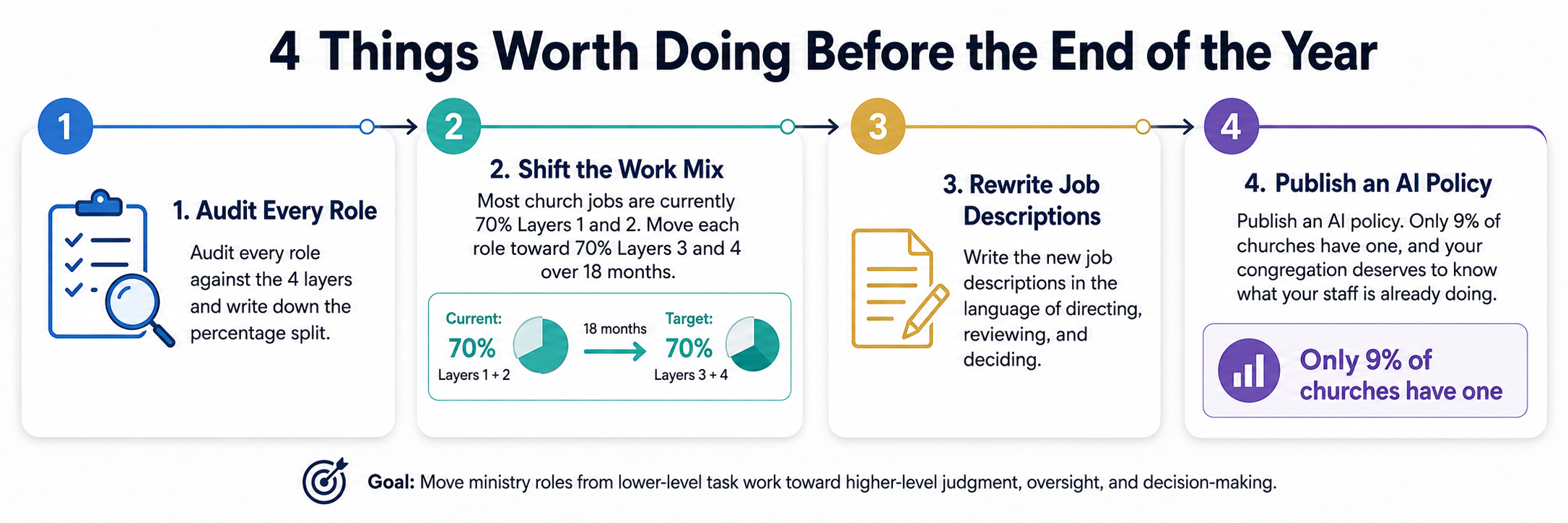
Audit every role against the 4 layers and write down the percentage split. Most church jobs are currently 70% Layers 1 and 2. Move each role toward 70% Layers 3 and 4 over 18 months. Write the new job descriptions in the language of directing, reviewing, and deciding. Then publish an AI policy, because only 9% of churches have one, and your congregation deserves to know what your staff is already doing.
One last thing.
Every layer AI can reach is a layer about output. Your worth was never stored there. The church has been saying so for 2,000 years, that your dignity was assigned before you produced anything, and it holds whether you ever produce anything again.
That may be the most practical thing you can preach this year.
I have been writing a whole book about this, built around 3 sets of practices for becoming the kind of person and the kind of church a machine cannot replicate. SOUL for calling. SIGNAL for truth. SANCTUARY for belonging.
More on that soon.
For this week, just run the audit. Open your calendar and mark every block: cart or pallbearer.
You will be surprised how much of your week is cart work, and how little of your week is spent on the thing only you can do.
Go be irreplaceable,

Kenny Jahng
Chief Innovation Officer
AiForChurchLeaders.com

Responses