
AI for Sermon Prep: 3 Guardrails Every Pastor Needs
Nov 08, 2026
If you preach, you may already use AI somewhere in your sermon prep. It can help you brainstorm ideas, sketch an outline or gather background on a passage.
Any AI draft needs a careful review before you preach from it. You are responsible for every word you preach.
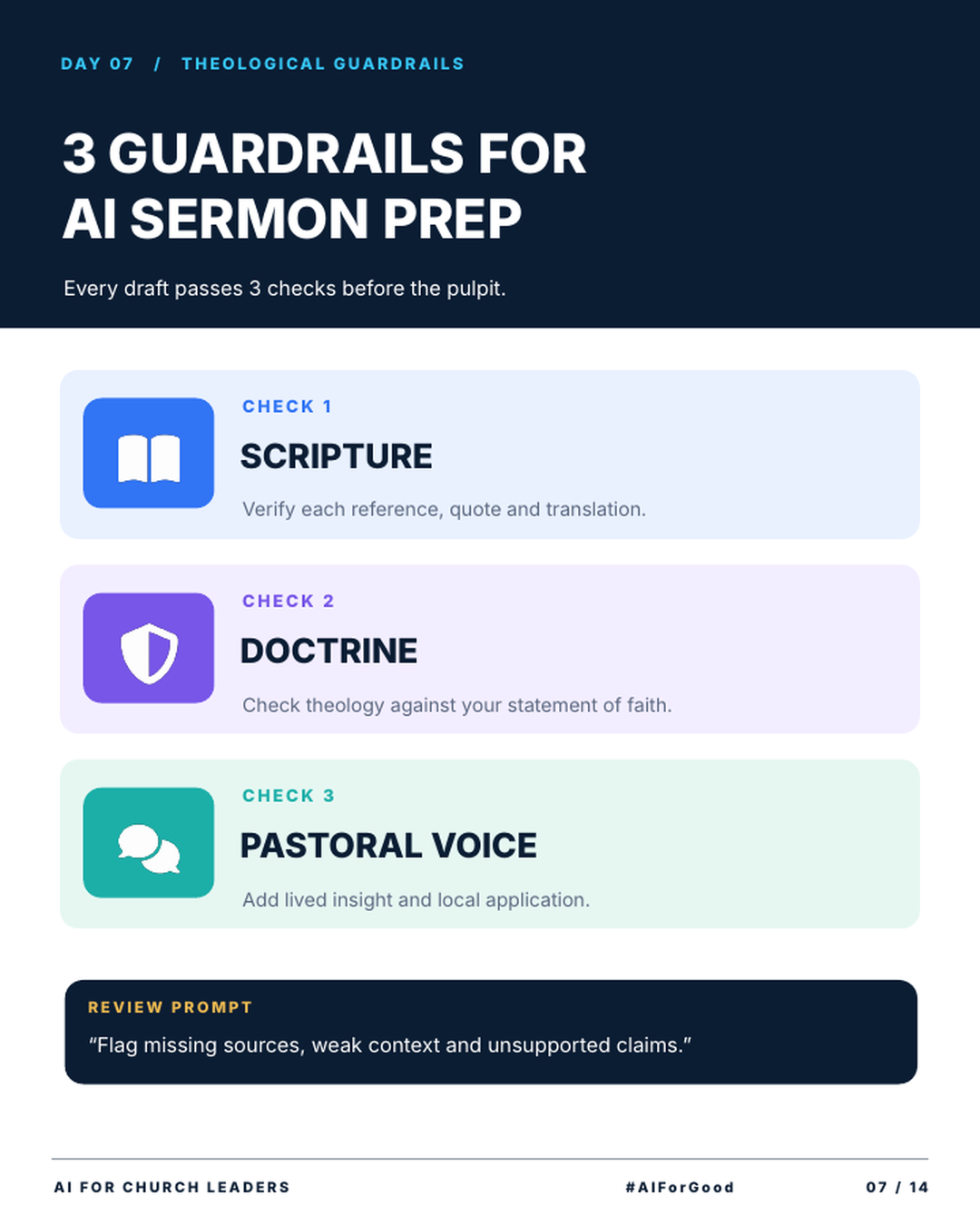
This guide gives you 3 checks to run on every draft. They cover Scripture, doctrine and your pastoral voice. You will also get a short review prompt you can paste into any AI tool.
How are pastors using AI for sermon prep?
Pastors already use AI in their study. In a June 2026 study from Barna and Gloo, "Half of all pastors (50%) say they use AI for brainstorming or idea generation." The same study found "nearly a quarter (24%) report actually writing or editing sermons with AI's help."
An AI chatbot is an app like ChatGPT or Claude that writes text when you type a request. That request is called a prompt. The chatbot writes fast, and its answers can sound confident. Some of those answers are wrong.
If you are still deciding whether AI belongs in your study, start with this look at whether it is wrong for a pastor to use AI to write a sermon. The 3 checks below assume you have decided to use it with care.
What are the 3 guardrails for AI sermon prep?
Every draft passes 3 checks before the pulpit. Run them in order.
Check 1: Is every Scripture reference correct?
Verify each reference, quote and translation. AI tools sometimes make up a Bible reference or attach the wrong verse to an idea. This is called a hallucination.
Open your own Bible for every verse in the draft. Make sure the chapter and verse numbers match the words. Make sure the wording matches the translation the draft names.
Check quotes from authors and church history too. Find the original source for each one. If you cannot find it, cut the quote.
Check 2: Does the theology match your statement of faith?
Check the theology against your statement of faith. AI tools learn from a huge amount of text written from many points of view. A draft can mix ideas from traditions your church does not hold.
Read the draft with your statement of faith open beside it. Mark any line that seems unclear or off. Talk through those lines with an elder or a trusted pastor friend.
You can also ask the AI tool to explain its claims. Ask, "Which theological tradition does this point come from?" Then test its answer against your own study.
Check 3: Does it sound like you and fit your church?
Add lived insight and local application. You know your people and your church's current season. Put that knowledge into the draft.
Read the draft out loud. Change any line you would never say. Replace general examples with stories you have permission to share.
Then ask what this passage means for your church this week. Write that application yourself. This is the part of the sermon only you can bring.
How do you use the review prompt?
The infographic includes a short review prompt. Paste your draft or outline into your AI tool. Then add this line:
"Flag missing sources, weak context and unsupported claims."
The AI tool will point out places that need more support. Treat its list as a starting point. Check each flag yourself with your Bible and your study tools.
Run this prompt after your 3 checks. It can catch details you missed on the first pass.
Key terms to know
AI chatbot. An AI chatbot is an app you type or talk to, and it writes a reply in plain language.
Prompt. A prompt is the request or question you give an AI tool.
Hallucination. A hallucination is when an AI tool states something false as if it were true, such as a made-up Bible reference.
Statement of faith. Your statement of faith is your church's written summary of what it believes.
Pastoral voice. Pastoral voice is the way you speak to your own people, shaped by your life, your study and your church.
AI can help you prepare to preach. Every draft still passes 3 checks before the pulpit: Scripture, doctrine and pastoral voice.
Try this this week
Take one AI-assisted outline or draft from your study this week.
- Check every Bible reference against your own Bible.
- Read the draft beside your statement of faith and mark any unclear lines.
- Read it out loud and rewrite anything that does not sound like you.
- Add one local application for your church.
- Paste the draft into your AI tool with the review prompt and check each flag it raises.
Join AIforChurchLeaders.com to access the training library and courses that help you level up your AI skills and fluency for ministry.
Frequently asked questions
Is it okay for pastors to use AI for sermon prep?
Your church and your conscience should guide that choice. AI can help with study and planning when you use it with care. If you use it, run every draft through the 3 checks.
Can AI get Bible verses wrong?
Yes. AI tools can give a wrong reference, mix up wording or mismatch a translation. Check every verse against your own Bible before you preach it.
How do I keep my sermon sounding like me if I use AI?
Read the draft out loud and rewrite lines you would never say. Add your own stories, study and local application. The more of your own work you add, the more it sounds like you.
What should I check before preaching a sermon I prepared with AI?
Run the 3 checks: Scripture, doctrine and pastoral voice. Then use the review prompt: "Flag missing sources, weak context and unsupported claims." Check each flag yourself.
Should I tell my church I use AI in sermon prep?
That is a decision for you and your church leaders. Talk it through together, then write your answer into your church AI policy. Being open about how you use AI can help your people trust your preparation.