Hey friend!
Someone new sat in your service last Sunday.
Maybe they filled out a connection card. Maybe they slipped in, sang along, and slipped back out to their car before you ever caught their name. Either way, they made a real effort to show up somewhere unfamiliar, and by Tuesday most of them have heard nothing from you at all. The week fills up, Sunday comes back around, and that name on the connection card turns into one more guest you never saw twice.
The hardest part already happened. Getting a stranger to walk through your doors for the first time is the toughest thing on the whole list, and Sunday pulled it off. Following up is the part you can control, and it keeps getting lost in a busy week.
So today I'm going to walk you through the three-email welcome sequence that turns a first-time guest into someone who comes back, and give you a prompt that writes the whole thing in your church's voice.
Let's walk through each one.
The first 72 hours decide whether they come back.
A guest's memory of Sunday fades faster than you'd think.
By the time they're back at their desk Monday morning, the warmth they felt in your lobby is competing with a hundred other things pulling at their attention. The window where a follow-up feels personal is short, roughly three days. Send something warm inside that window and it reads as care from a real person. Past that, the same words start to feel like a mass mailing.
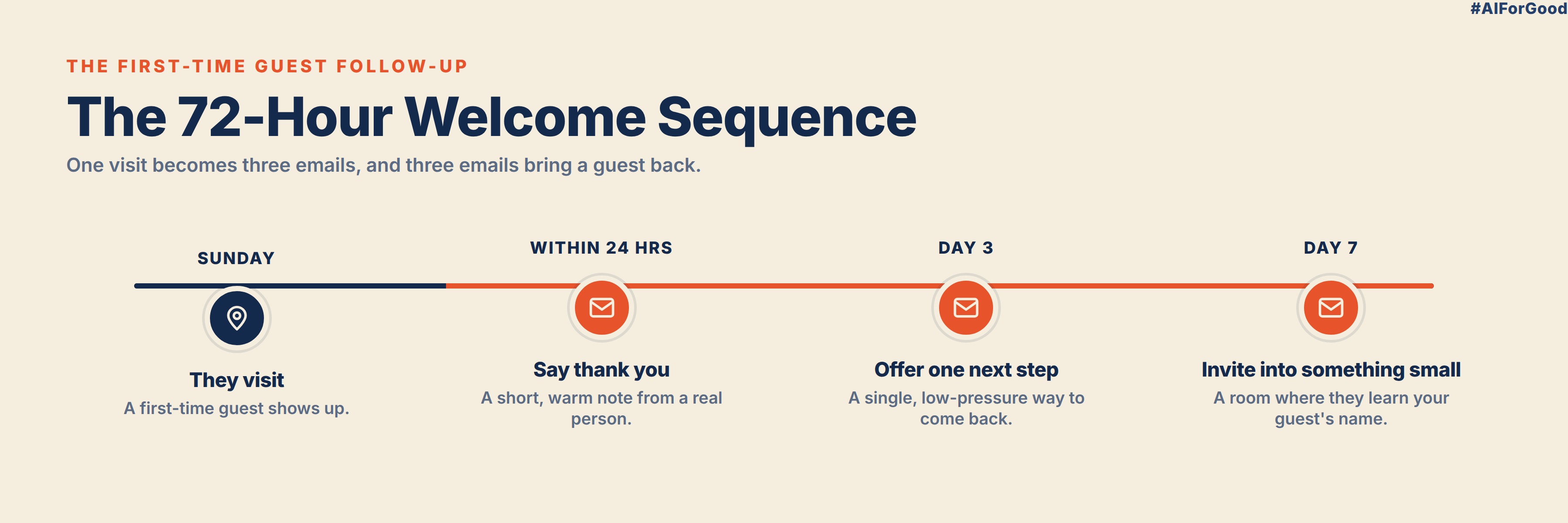
So move fast, even before the wording feels perfect. A short, warm note on Monday is what brings people back. Assign one person to send it, keep a simple running list of who visited, and protect that 72-hour window like it's the whole job. Because for the first email, it mostly is.
Your guest is deciding whether they belong here.
Every first-time guest carries one question the entire time they're with you.
They want to know whether people like them fit in a place like this. The preaching and the music matter, and underneath both sits that deeper question about belonging. Your follow-up either answers it or leaves it hanging. So the job of these three emails is to keep answering it, one small signal at a time, until they believe the answer is yes.
That reframes everything you write. You are the guide here, and the guest is the hero. So each email stays about them: their next easy step and their sense of belonging here. That keeps every line centered on the person reading.
Email 1 thanks them within 24 hours.
The first email does one job: say thank you the way a real person would.
Keep it to three or four sentences, and name the specific Sunday they came. Leave out the church calendar, the giving link, and the long list of ministries. A first-time guest who opens a warm, short thank you within a day feels noticed, and being noticed is the entire point of touch one. Sign it from a real person whose name they can see.
Email 2 gives them one easy next step.
The second email hands them a single low-pressure way to come back.
One step. Just one. When you offer a guest a list of nine ministries, you hand them a decision, and decisions create hesitation. So choose the one on-ramp that fits most newcomers, whether that's a newcomer coffee, a short start-here gathering, or next Sunday itself with a note about where to park and what to expect. Make it clear this is an invitation, and that saying yes commits them to nothing beyond showing up.
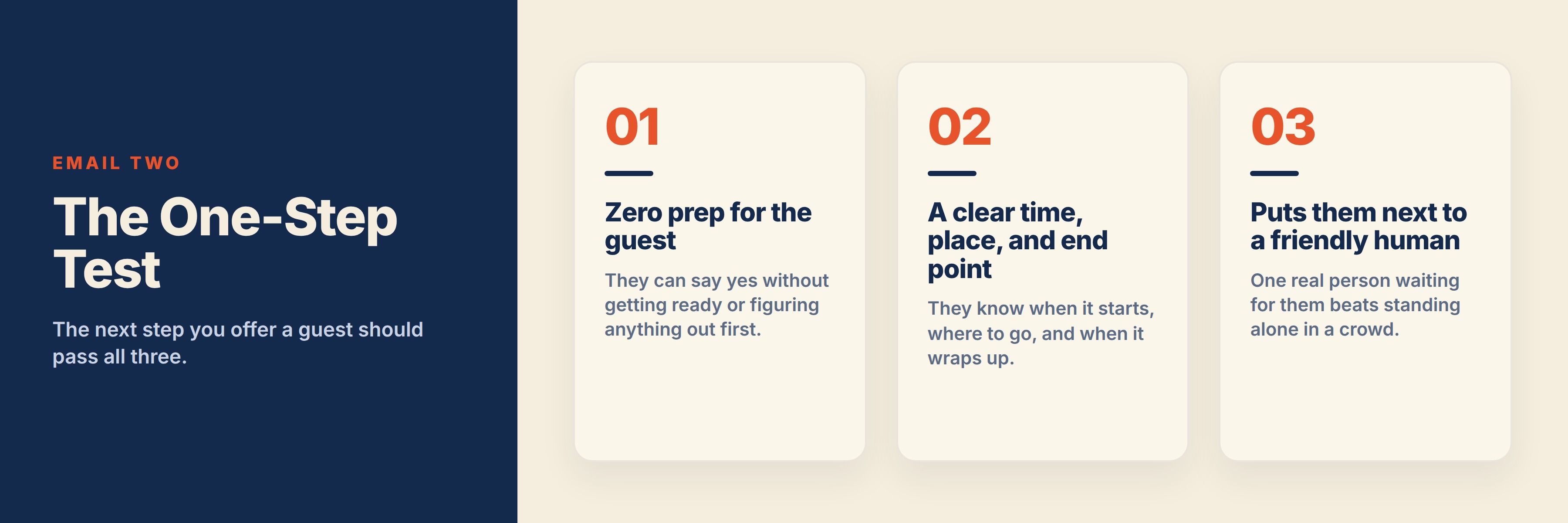
Here's a quick way to pick the one step you offer:
- It should require zero prep from the guest.
- It should have a clear time, place, and end point.
- It should put them next to a friendly human.
Get those three right and email 2 does its work.
Email 3 invites them into something small.
The third email moves them from attending toward belonging.
This is where you point them to a room small enough to learn their name. That might be a table, a class, or a serving team of four people setting up chairs before the service. Belonging happens in small rooms, and the guest who joins one is usually the guest who stays. Keep the tone light and the door wide, and remind them there's no experience or commitment required to say yes.
You now have the full framework. You've got the three emails, the timing, and the one job each one needs to do. The last piece is the writing itself, and that's the part I built a prompt for. It drafts all three emails in your church's own voice, with the fill-in-the-blanks already in place, so you set it up once and reuse it for every guest who walks in.
Grab the full copy-paste prompt here ⤵️
Paste this into ChatGPT or Claude, answer the bracketed questions once, and you'll have a reusable welcome sequence ready to send.