Hey friend!
You are going to miss a Sunday you did not plan to miss.
It does not take anything dramatic. A car accident on the way home from a meeting will do it. So will a parent dying in another state, or a diagnosis that puts you in a hospital bed for two weeks starting tomorrow morning.
Your church does not collapse when that happens. Your staff makes a long run of small bad decisions over the next few weeks, because everything they need to know lived in one head and that head is unavailable.
We have plenty of research on pastoral succession. A 2019 ECFA survey found 37% of church boards had held zero conversations about a succession plan. BoardSource reported in 2021 that only 29% of nonprofits had a written succession plan at all. Barna surveyed 585 Protestant senior pastors in September 2022, and 40% said they had thought about the need and had too many other ministry concerns to do anything about it.
All of that research is about who replaces you in 10 years. I want your attention on the smaller question underneath it. If you are unreachable for a month starting next week, does anyone besides you know how to run your church?
Nobody is measuring that one. You can still answer it this week.
Your church runs on things one person knows and has never written down.
Walk your building in your head. The security code for the side door. Which elder to call before the board hears anything. The name of the woman whose husband is dying and who does not want visitors yet. The login for the giving platform. The reason you stopped booking a particular guest speaker.
None of that is in your church management software. All of it keeps the place running.
The Faith Communities Today study found the average age of US religious leaders rose from 50 in 2000 to 57 in 2020. We are an older profession than we were a generation ago. Plan accordingly.
A continuity document answers 6 questions, and passwords are the easiest one.
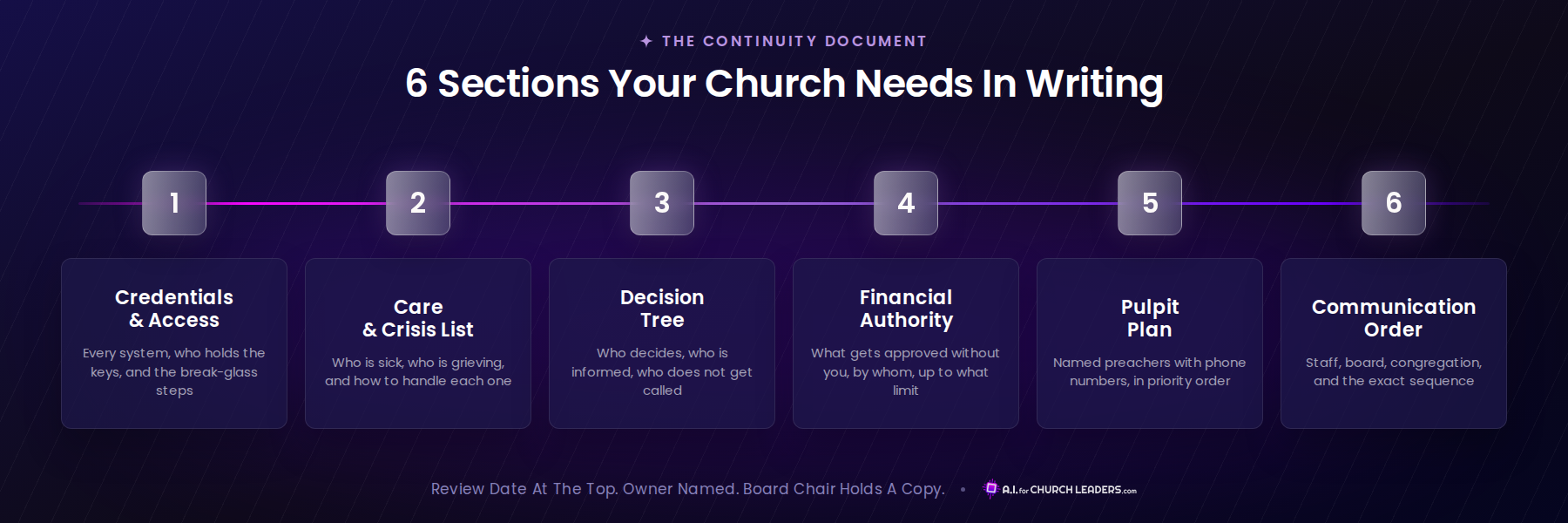
Credentials and access. Every system, who holds the keys, and how someone gets in without you.
- The hospital and crisis list. Who is sick, who is grieving, who is in a situation a stranger would make worse.
- The decision tree. Who decides what while you are out, and who only gets informed.
- Financial authority. What can be approved without you, up to what dollar amount, by whom.
- The pulpit plan. Named people who can preach this Sunday, with phone numbers, in priority order.
- The communication order. Who tells the staff, who tells the board, who tells the congregation, and in what sequence.
Credentials are the only section a password manager solves for you. My guess is you would start there and stop there, because the other 5 require writing down things you have never said out loud.
Start with the hospital list, because it decays faster than anything else you own.
Your database will not tell a substitute any of this. A family in your congregation lost a baby this spring and is not ready for a visit. A man you met with recently is one conversation away from leaving his marriage, and he told you that in confidence. There is a widow who would be humiliated if anyone but you brought up her finances.
Nobody can reconstruct that after you go down. Someone will try, and they will call the wrong person with the wrong tone at the worst possible moment.
Write it out with names, dates, current status, and a one-line note on how to handle each person. Then protect that file the way your finance team protects bank credentials, because it is more sensitive than the bank credentials.
Credentials need a break-glass procedure that two people execute together.
A sealed envelope in a desk drawer fails for obvious reasons. One trusted assistant holding everything fails too, because your church still depends on a single person being reachable.
Put every credential in a password manager with an emergency access feature. Name two people who can trigger it, require both of them, and log it when they do. Your board chair and your executive pastor is a reasonable pairing. Test it once, with you watching, before you need it.
Name the decision tree now, because a crisis is when people improvise badly.
Whoever is standing closest to the problem will run the first 72 hours. That person invents a process under stress, and their version is worse than the one you could write calmly this afternoon.
Write down the first 3 phone calls in order, by name and number. Write down what your staff can approve without you and where the ceiling sits. Write down who does not get called, because a lot of crisis management is keeping the wrong person out of it early.
If nobody reviews it, your staff will act on information that is already wrong.
Staff leave. Vendors change. The family on your care list moves through their grief. The elder you named as first call may not be at your church next year.
Put a review date at the top of page one and own it yourself. Anything older than 6 months gets treated as unverified until someone walks it line by line. A stale continuity document is dangerous the same way a stale fire evacuation map is dangerous.
Write it this week, before the reason to write it arrives.
The format takes 20 minutes. The real work is answering 6 questions honestly, in writing, about your own absence, which is why most of us never get to it.
So let AI run the interview. Give it the questions, let it push back on your vague answers, and let it hold everything while you think out loud.
Paste this into Claude or ChatGPT, fill in the brackets, and answer in whatever order it asks. Give it 45 minutes.
FORM FACTOR: Conduct a structured interview with me, one question at a time. Do not move to the next question until I have answered the current one. At the end, output my complete raw answers organized by section.

AUDIENCE: I am [YOUR ROLE] at [CHURCH NAME], a [SIZE] congregation in [CITY, STATE]. My staff is [NUMBER] full-time and [NUMBER] part-time. Our governance structure is [ELDER BOARD / DEACON BOARD / DENOMINATIONAL / OTHER].

SUBJECT MATTER EXPERTISE: Act as an experienced church operations consultant who has managed unplanned senior pastor absences. You understand church governance, pastoral confidentiality, and the difference between long-term succession planning and short-term continuity.

TASK DETAILS: Interview me to build an emergency continuity document covering a sudden absence of 1 to 12 weeks. Work through these 6 sections in order:
1. Credentials and system access
2. Hospital, crisis, and sensitive pastoral care list
3. Decision authority and escalation tree
4. Financial approval authority and limits
5. Pulpit coverage plan
6. Communication sequence and messaging

EXAMPLES OR EVIDENCE: For each section, ask follow-up questions when my answer is vague. If I say "the elders would handle it," ask which elder by name, what their phone number is, and what happens if that person is unreachable. If I name a system, ask who else can currently access it today.

REQUIREMENTS AND RESTRICTIONS: Ask one question at a time. Do not accept role titles where a name is required. Do not let me skip the pastoral care section. Flag any answer that depends entirely on my own availability. Do not ask me to type actual passwords into this chat; ask where credentials are stored and who can retrieve them. At the end, list every question I answered incompletely.
The interview gives you raw answers in a chat window. Your board cannot file a chat window.
So the tool below turns that transcript into two finished pieces. The first is the complete continuity document, organized into the 6 sections, with a review date, a named owner, and a distribution list at the top. The second is a one-page crisis card, short enough to print and tape inside a cabinet door, listing the first 3 phone calls, the break-glass steps, and your pulpit backups in order.
Grab the transcript-to-document prompt here ⤵️ ⤵️