Hey there!
Imagine it's 11:47 on a Tuesday night, a stranger in your zip code is reading your church website in the dark.
She will probably never call your office. She will never fill out a form. She is spiritually curious, a little guarded, and deciding in private whether your church feels safe enough to visit. For her, your website is doing the work of a greeter, a lobby, and a first conversation all at once. Here is the challenge: most church websites get reviewed by one set of eyes, usually the pastor or the volunteer who built the site. Meanwhile, that guest is reading those same pages through at least seven different filters.
So today, I want to walk you through the 7 expert lenses your church website deserves to be reviewed through, and then show you how AI lets you run all seven reviews in a single sitting.
Let's meet the panel.
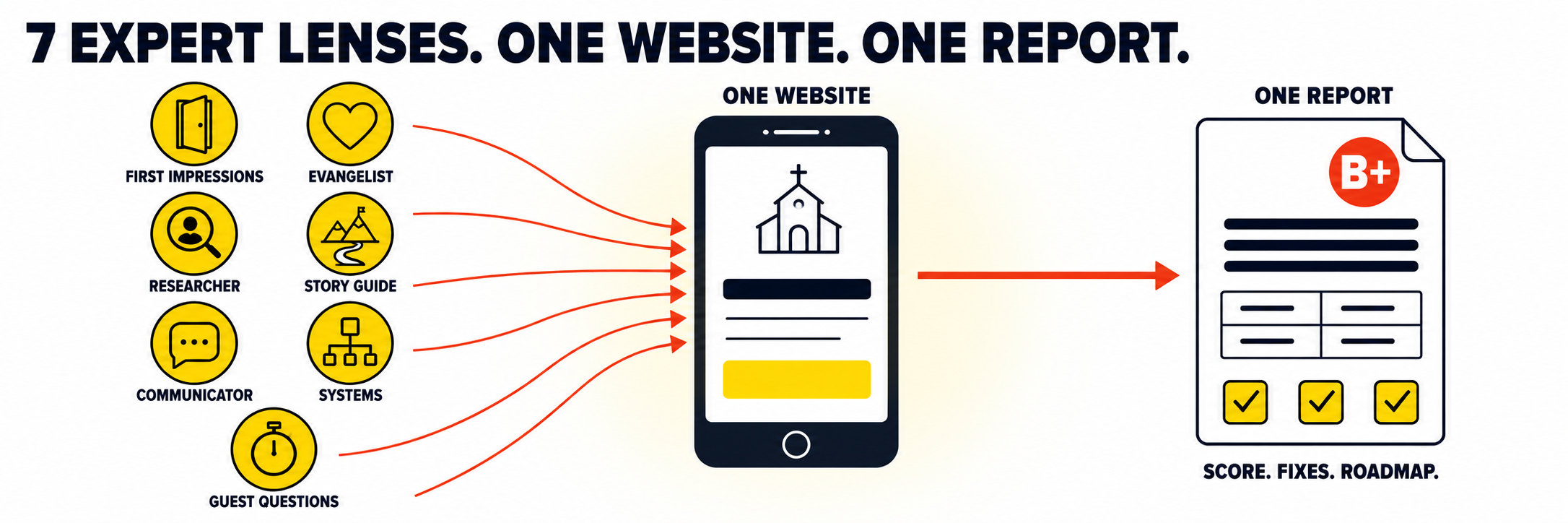
Lens 1: The first impressions strategist treats your website like your actual front door.
This expert has one obsession: removing friction and fear for the first-time guest.
Every extra click raises the cost of showing up. So does a buried service time or a wall of vague stock photos. This lens runs the five-second test on your homepage: within five seconds, can a stranger tell what you offer, how it helps them, and what to do next? It also hunts for the small anxieties churches forget about, like where to park, what to wear, and how long the service lasts. A guest who finds those answers ahead of time shows up calm and ready. When the answers are missing, staying home feels easier.
Lens 2: The evangelist checks whether a doubter would feel safe here.
This lens reads your site as someone exploring faith with real questions still open.
Does your language assume the reader already believes? Is there a single sentence on the site written for someone who is still unsure? An evangelist for the spiritually curious looks for phrases like "questions welcome" and "come as you are," backed up by pages that actually deliver on them. This lens also flags anything that feels like a sales funnel for souls. The curious can smell pressure through a screen, and they close the tab the moment they do.
Lens 3: The openness researcher knows exactly what curious people are afraid of.
This lens reads your site through national research on spiritual openness.
Barna Group's studies found that 82 percent of U.S. adults believe in or are open to a spiritual dimension, and 74 percent want to grow spiritually. The same research describes the spiritually curious as eager to explore their questions in a safe, nonjudgmental setting, and easily put off by shallow or formulaic answers. The audit turns that into a working guest profile: someone who fears being judged, sold to, or treated like a project, and who wants room to explore without committing to anything. This lens asks whether your site offers a path for someone who wants to lurk for a while. Can they watch a service online? Can they read what you believe without handing over an email address? A site that respects that guardedness earns trust one anonymous visit at a time.
Lens 4: The StoryBrand guide makes your guest the hero of the story.
The SB7 framework gives this lens its checklist.
The guest is the hero. Your church is the guide, showing empathy and competence. The site needs a simple plan, ideally three steps, that moves a stranger toward belonging. It needs one clear primary call to action, like Plan Your Visit, plus a low-commitment transitional option for the person who is far from ready. When this lens finds a homepage headline about the church's vision or its building campaign, it flags a hero problem. Guests scroll right past a story that has no room for them in it.
Lens 5: The communicator translates your insider language into plain English.
Every church develops a dialect, and this lens catches it.
Phrases like "do life together," "get plugged in," "unpack the Word," and "worship experience" feel warm to members and read like code to a newcomer. This expert swaps each one for plain language an 8th grader would follow. The same lens checks the practical foundations: how the site reads on a phone, how fast pages load, whether your city name appears for local search, and whether the fonts and contrast are readable. Clarity is a form of hospitality.
Lens 6: The executive pastor asks what happens after the click.
This lens thinks in systems and follow-up.
A beautiful website with no clear pathway is a lobby with no doors. The executive pastor lens checks whether a guest can take one obvious action, whether the church will respond quickly when they do, and whether anyone is tracking what percentage of visitors take that step. It also looks for the follow-up promise: if someone texts a question or fills out a card, what happens in the next 48 hours? Growth lives in these unglamorous systems.
Lens 7: The guest-first consultant answers the three questions every guest is really asking.
This lens works from a simple premise about how guests decide.
A guest deciding about Sunday needs three answers fast: when do you meet, where are you, and what will you do with my kids? This lens pulls out a stopwatch and times how long each of those answers takes to find. If any of the three takes more than five seconds, the site fails a large share of its visitors, including the churchgoers relocating to your town who move quickly and decide from their phone.
AI lets you put all 7 experts in the same room for the price of a prompt.
Hiring these seven consultants separately would cost thousands of dollars and produce seven separate reports you would still have to reconcile yourself. A well-built mega prompt taps the expertise of the entire panel at once. The AI reads your actual pages, quotes your actual sentences, and evaluates every line through all seven lenses in one pass. Then it consolidates the findings into one prioritized report:
- A Front Door Score your team can rally around and improve
- A jargon translator listing the exact phrases pushing newcomers away
- Copy-and-paste rewrites you can ship the same day
- A roadmap sorted into 7-day, 30-day, and 90-day actions
Just imagine 7 experts arguing in order to produce one report as they force trade-offs, so you end up with a ranked list of suggestions where the guest experience always wins.